You can understand Economics

31 August 2009

Masonry Heaters, the Anti-Pellet


The American wood stove, of whatever breed, is a terror! It requires more attention than a baby. It has to be fed every little while, it has to be watched all the time; and for all the reward you are roasted half your time and frozen the other half... and when your wood bill comes in you think you have been supporting a volcano. -Mark Twain, 1891, Some National Stupidities

My neighbour succumbed to trend and bought a pellet stove; a bit of cheap technology, another collection of moving parts to make our lives better and foster some illusion of self-sufficiency. He then discovered that it was grid-dependent; each time the power went off, carbon monoxide alarm sounded --- In a pellet stove CO backs up into the house when the fan does not run.

To make the poison gas go away, he had to buy a generator as well. Now any time of the night when the electricity fails, my neighbour is wheeling that generator out, slopping gasoline into it and pulling the starter cord.

The pellets are trucked in from Georgia. The single startup firm in Vermont which manufactures pellets for the Acorn Coop, is utterly dependent on chemicals which are imported from China. We decided to go a different route.

The Kachelofen, (Masonry Heater) with its 90% combustion efficiency, no moving parts, as well as the potential to last for hundreds of years given competent care, became popular in Europe centuries ago, as wood resources became scarce and expensive. Is this at all familiar to you, energy turning from a buyer's to a seller's market?

It may seem that we have infinite wood resources here in Vermont. Boutique wood: cut, split, delivered at $250 the cord. Yet, about a century ago, Vermont had been virtually clear-cut. Resource extraction (tax-free) had pushed subsistence to the most marginal lands. We are well on our way back there again, seeing arguments about returning Vermont's marginal land to food production, if we are to be self-sufficient...

But, do we have Kachelofens in Vermont? Almost not. Twain wrote, It is certainly strange that useful customs and devises do not spread from country to country with more facility and promptness than they do. Henry George also wrote that Free trade consists simply in letting people buy and sell as they want to buy and sell... blockading squadrons are a means whereby nations seek to prevent their enemies from trading; protective tariffs are a means whereby nations attempt to prevent their own people from trading. What protection teaches us is to do to ourselves in time of peace what enemies seek to do to us in time of war.

Self-sufficiency is a myth; a free Vermont with access to global trade is sustainable. We could also manufacture much better stoves than the EPA would have allowed us, as they do in the EU today...

A bit more from Mark Twain about the Kachelofen: To the uninstructed stranger it promises nothing. It has a little bit of a door...which seems foolishly out of proportion to the rest of the edifice. Small-sized fuel is used, and marvelously little of that. The process of firing is quick and simple. At half past seven on a cold morning the servant brings a small basketfull of slender pine sticks and puts half of these in, lights them with a match, and closes the door. They burn out in ten or twelve minutes. He then puts in the rest and closes the door...the work is done.

All day long and into the night all parts of the room will be delightfully warm and comfortable... the cost is next to nothing; the heat produced is the same all day, instead of too hot and too cold by turns...

26 August 2009

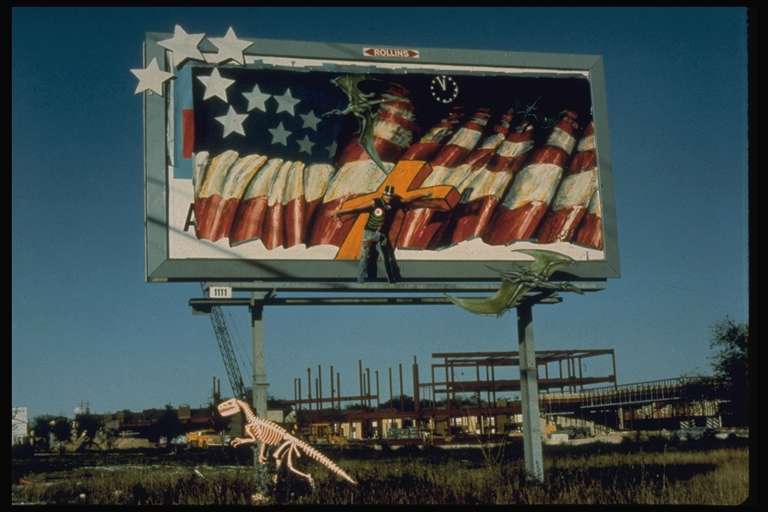
Maybe Vermont Should Have Billboards


If we did have billboards, (aside from Fairpoint billboards which seem to be exempt from Vermont's anti-billboard legislation) I could invite my old friend Ron English to come up to the Green Mountains and 'improve' them.

Not that Vermonters need any GM billboards as an impetus to go and trade their dinosaurs for a wasteful Pickup 'Truck' SUV that will never pick anything up, not ever. We've already got the Obama/Sanders 'Handouts for Hummers' programme for that incentive... oops I meant 'Cash for Clunkers'.


But the usually environmental, organic-eating, hybrid or suburbu-driving Vermonters might question their complacency if ol' Ron came up to the Green mountains and did one of his famous billboards. Perhaps shocking the liberal Left out of blind faith in the Obama Bailout:


You can read more about the inextinguishable Ron English here. Here are some recent pictures of Ron's work. The historical classics are here, among them CAMEL JR:

24 August 2009

Legislative Changes that We Need to Survive


The Case for Local Wheat and Bread in Vermont by Erik Andrus (Good Companion Bakery) is extraordinarily well-written; nay, timeless. It shows what we need to do if we wish to continue to eat in Vermont, yet very little of it can happen within the current legislative and tax milieu. Secession or no secession.

Somalia have less energy than we do, in Vermont we'll have less energy soon and lots of walking too... are they better off? In Somalia, most of the land is owned by a few families that keep it out of production, preferring to skim the cream and speculate on the rest.

In Vermont we have an ass-backwards tax system that encourages speculation, by taxing us on capital improvements to the land; e.g. improving fertility through means natural or petrochemical, rather than taxing on the unimproved value, a value which is created by the community. That value is a common resource; our Commons.

Let me elaborate. Fertility added to the soil (maintained through constant renewal) is Capital. It is not the Land itself, which is part of Vermont's Commons. The Towns and the State Government currently act as a parasite on the labour of Vermonters and especially on the farmer, who, acting as capitalist, improves the land.

The Towns serve to represent absentee landowners, who manifestly pay little to no tax on the speculative value of their landholdings. This windfall makes the value go up, why would I sell it to you today for $100,000 if it may be worth $150,000 next year, and also pay no tax if I hold it out of use? The end result is development in sprawl --- and the destruction of good agricultural land. You see this landscape today, all over Vermont. Suburbia is made though the driver of land speculation, which should rightfully be discouraged through taxation, but is today not only encouraged but highly subsidised by our 'representatives'.

Homesteaders, on the other hand, are taxed highly. In the town where I live, residents have to pay a higher property tax rate than nonresidents... for no municipal services or amenities, not so much as a crosswalk, a bike rack, a park & ride, or a school zone. Homesteaders get one day of rant per year at Town Meeting, as a result of which nothing changes.

Among Vermont's absentee landowners are IBM, Middlebury College, Vermont Yankee, various logging concerns and springwater bottling companies... you get the picture. Here's how the game works: Draw off the natural resources, get rich and pay nothing (in fact Montpelier will give you incentives and subsidies). Try to make an honest living, pay high taxes --- and stay poor. Labour and Capital are in the same boat, and keep getting played off against each other by the Left. It is the tragic history of an ever-poor state, not dissimilar to Ireland in the 19th Century or Somalia today.

It is imperative that the Towns change the property tax structure to recapture the lost revenue of the Commons. The destruction of speculative land values is already being accomplished by the land bust of this past year. Then, the rest of what Mr. Andrus writes can easily fall into place. It's that or starvation and mass migrations.

19 August 2009

Everyone Tries to Walk Away with a Piece


Guns and Butter
is an excellent radio interview with Dmitry Orlov: 'Orlov's repeated travels to Russia throughout the early nineties allowed him to observe the aftermath of the Soviet collapse first-hand. Being both a Russian and an American, Dmitry was able to appreciate both the differences and the similarities between the two superpowers. Eventually he came to the conclusion that the United States is going the way of the Soviet Union. His emphasis is on all the things that can still be made to work, and he advocates simply ignoring all that will fall by the wayside.'

Usually I try to ignore what's happening back in the States, as it's too overwhelming. Try to focus on Vermont. Too much on the Web focuses on the 'We', as if there's any real nation of 'We'. There ain't, though few will see that the emperor has no clothes until imports dry up. Most're assuming that the US will last forever, just as folks in the Soviet Union assumed. Yeah. Virtually overnight, most of the loyal republics elected to go their seperate ways.

When I say 'We' I mean Vermont. A viable nation; perhaps together with Maine and the Maritimes, perhaps not. Economically, we're on our own anyway.

At some point the US Empire will no longer be able to borrow from overseas. The USD will have lost its status as the world's reserve currency. The US Empire, regardless of the new administration, are aligning with the last days of the USSR, with its record trade and fiscal deficit, military expenditure and overreach, and currency failure.

The new administration in Washington are staking everything on re-starting economic growth at ever-increasing speculative rates. At some point, people are going to realise, 'this cannot go on'. Do you believe that it can go on?

Orlov's blog is at cluborlov.blogspot.com

17 August 2009

Scott Nearing, Vermont's Founding Father?


Your government is no longer mine - Scott Nearing, The Making of a Radical: A Political Autobiography [Harborside, Maine: Social Science Institute, 1972, p. 152]

We maintain that a couple, of any age ... with a minimum of health, intelligence and capital, can adapt themselves to country living, learn its crafts, overcome its difficulties, and build up a life pattern rich in simple values and productive of personal and social good. - Scott & Helen Nearing, The Good Life'.


Recently, Thomas Naylor was kind enough to invite me to a lecture at Middlebury College about Scott Nearing, an anti-war radical who was blacklisted from academia for, among other things, his unpopular stance against child labour (The Solution of the Child Labor Problem).

Nearing became a Vermont Homesteader in the mid-Twentieth Century and successfully set up a large scale maple sugaring operation in Winhall, Vermont. He and his wife Helen wrote a book about the experience called, Living the Good Life: How to Live Simply and Sanely in a Troubled World. The Nearings also travelled the world to teach about (among other things) the importance of the rebuilding soil. This was at a time when almost nobody questioned the rise of agribusiness and factory farming, despite the Dust Bowl.

Did Nearing's life and work change the course of Vermont history? He certainly attracted more than his share of interesting people to Vermont, reversing the brain-drain. Yet Nearing gets scant mention in the Vermont histories that I've read.

Nearing's Biographer Saltmarsh wrote, 'Nearing moved through a series of secessions — from Christianity, from politics, and finally from American society itself. He voyaged to the wilderness as if on a pilgrimage to a sacred place. His experience, along with a deeper understanding of American culture, led to the inescapable consciousness that capitalist cultural dominance was too strong to eliminate and therefore too powerful to control or mold...'

In 1945, Nearing wrote to Truman, who had just destroyed two cities in Japan with atomic bombs, 'Your government is no longer mine'. Is Scott Nearing the spiritual 'Founding Father' of the Second Vermont Republic?

Regardless of your opinion, this is essential reading for anyone interested in the evolution of the Vermont independence movement... whether you're working toward secession or just feel that it's important to build the soil and sequester carbon. The Good Life is available from GoodLife.org or from Amazon. A good short biography may alse be found on the web here.

12 August 2009

What Vermont and Russia have in common


The 1990s economic disasters in Russia under Boris Yeltsin hold a lesson for Vermont, itself seeking independence from a collapsing empire. What do vast Russia and tiny Vermont have in common?


The lesson concerns the privatisation of what we're calling the Commons; that is, the Land, the natural resources, all natural opportunities, anything provided by nature that is not the product of our work. It is the life and work of each community that adds to the value of the Commons. Currently, the value of the Commons is largely siphoned off and removed from Vermont. We resemble a colony, rather than a State. Speculation raises the market value of land especially, to a point where we can barely subsist. If you recall what the news media said, they said that the 'housing' bubble burst. What exactly burst? Was it the cost of your depreciating housing stock with the leaky roof, or was it the lucky location of that house that added so much to its market value?


Back in the nineties, Prime Minster Evgeny Primakov proposed a resource-rent tax to finance the nation's recovery from the collapse and breakup of the USSR. His proposal was to tax the profits of natural resources, which have production costs and high windfall. That would have retained rather than liquidated the seventy-plus years of Soviet capital investment. A corrupt Duma chose to give the profits to their associates, who became the Oligarchs. The Duma did what our own esteemed legislature in Montpelier have been doing for even longer, that is, sell off the shares to non-Vermonters.


Professor Herman Daly of the University of Maryland, wrote a letter to the Duma in 1998, proposing the same. I am not sure if Professor Daly's letter or Primakov's proposal came first; I'm sure there were lots more people who felt the same way:


While it is true that land and natural resources exist independently of man. and therefore have no cost of production, it does not follow that no price should be charged for their use. The reason is that there is an opportunity cost involved in using a resource for one purpose rather than another, as a result of scarcity of the resource, even if no one produced it.


But if we tax wages and profits too heavily then the some of the value added to natural resources and land by labor and capital will indeed disappear. The natural resource throughput begins with depletion and, after production and consumption, ends with pollution. Putting the tax at the beginning of the resource flow through the economy (throughput) is better than putting it at the end. A resource tax at the point of depletion induces greater efficiency in production, consumption, and in waste disposal.


Mayor Yuri Luzhkov of Moscow cited the ‘stealing, squandering, and distribution of natural resources and the largest sectors of industry to those who could not support their development.’ Gary Flomenhoft, if you read vtcommons.org at all, has not only documented the exact same thing about Vermont, but has gone further than the Mayor and given it a dollar value.


In an independent Vermont, we have to decide what to do about our Commons. If we create a Leftist government, we'd have to 'take' back what is ours... and probably remain as marginalised in world trade as Cuba under the Castro brothers.


Or we could move to the right, make no changes, and trust in the 'invisible hand' to transform the current corporate owners into responsible capitalists, rather than speculators. This is Montpelier's current solution, also not viable. There is a third way.


The third way, neither right nor left, is for government to shift tax away from productive activity such as wages and capital investments, and collect the _unimproved_ value of land, resources, timber, radio frequencies, opportunities; that is, the Commons. In the classics of Economics (which virtually nobody in academia ever reads), men such as Adam Smith, Ricardo and Henry George, called the value of the Commons, 'Rent'. All three agreed that a tax on Rent would mean the least hardship on society. Nothing radical here, so far.


I think it would be a good idea to allow the titular 'owner' of any part of our Commons to retain some small percentage of the rental tax, in order to capitalise it for sale. This would draw 'local' economic activity back into the state in a way that far huger tax breaks have failed, as well as keep the IBMs of the world from crying to a truncated US for intervention. Vermont will remain a cash cow, drying up only slowly.


Critics of the third way (defined here) often cite the popular view, that keeping taxes low on undeveloped land also keeps it from being developed. That plays right into the hands of the speculators, who are used to virtually tax-free Vermont investments. All that keeping taxes artificially low accomplishes is to force leapfrog-style development ever outward, into the sprawl that you see today! Is that 'green', having to drive through the sprawl? Is it cost-effective for the wage-earner and capitalist, who has to pay the vastly increased infrastructural costs of sprawl?


I look forward to debating these and other ideas, and hope beyond hope that we will get the chance to debate them in the context of a free and independent Vermont. Please use the comments section to poke holes in my arguments, and add your own ideas!


The Basic Factors of the Production of Wealth, and their Functions

05 August 2009

Health 'Insurance': We're on our own.

Last night I with my local volunteer fire department did fire duty at the county fair. The only 'incident' that occurred was bandaiding a young man who came to our tent with a scrape. We also cut the rear silencer off our aging pumper to reweld, as the imported replacement is too difficult to get and too expensive for our tiny budget. We know that we're on our own; there's no government that can help us be a proper fire department. It is a generally accepted thing.

Not as generally accepted as with health care, which everyone needs (some more than others, but it averages out) as much as a fire department, maybe more. The political nonsense that's going on serves to distract from the overall collapse, let people think they are not on their own with regard to health care. This whole debate that we're having is a distraction, whilst the O-Team loot what's left of the country, borrow trillions from the Chinese and Saudis, consolidate control, and attempt an even greater imperial overreach than happened in the Bush years. I repeat, we're on our own.


(As if there's any we. Here in Vermont, I'm one of many successionists who have known this for a long time. You will have to decide for yourself, if you happen to live in the lower 47, whether to continue waving the imperial flag as hospital bills eat you out of house and home.)

We, hmmph. Sounds like a religion. Distractions seem to be religious in nature. George Orwell wrote, throw"...your mind open ... letting the ready-made phrases come crowding in. They will construct your sentences for you, even think your thoughts for you... at need they will perform the important service of partially concealing your meaning even from yourself."

It took a bit longer than Orwell thought, but I believe that we are there.