You can understand Economics

14 September 2009

CoLLapse hits the mainstream media


Wanted to share with you my discovery of one of the films shown at the Toronto Film Festival, Michael Ruppert's CoLLapse, which is provocative enough to have hit the mainstream media.

http://www.collapsemovie.com is sometimes hard to reach which may be technical, or the site may be swamped.

Here's what Ruppert's From the Wilderness Peak Oil Blog says:

CoLLapse is a film about me, my life, and the message I have come to deliver after more than thirty years on a very long path. Many of you who will read this have walked some distance with me and with each other along that path. I do not have to remind you that at this moment in human history, this film may be the last, best shot our movement has to break through into the mainstream. This Fall and Winter look to be very trying times for our species.

12 September 2009

The Destruction of the US Empire

What's significant is that someone besides a Vermont Secessionist wingnut is calling the Empire, the Empire.

Found this article today morning on one of the financial sites that I skim, the Daily Reckoning. They're selling something (not sure what) as is everybody else, but they have a good grasp.

I like Bill Bonner because he goes for the Empire in a vulnerable place, finance. Sorry, Vermonters, but solar panels, hybrids, illusions of self-sufficiency, off-grid-ness and stopping global warming (always the paper tiger) are not going to dump the Empire off our backs.

The Destruction of the US Empire

by Bill Bonner

09/11/09 London, England

Edward Gibbon described the happiest age of mankind as the period of the "five good emperors" between AD98 and AD180, when Marcus Aurelius died.

What was America's Golden Age?

It is much too soon to write the history of America's decline and fall. Still, that doesn't stop us from guessing.

We would name the period between the fall of the Berlin Wall and the fall of Lehman Bros - a period of only 19 years - as the peak of US power and wealth. Of course, Americans were dreaming during those years. The dreams were the usual imperial sort - that the US Empire was such a benefit to the rest of the world that the foreigners would support it indefinitely. Rome didn't take any chances; it forced its conquered nations to render tribute...slaves...gold...and wheat. The American empire depended on trade...and the dollar. As long as the United States had a commercial advantage, the empire was profitable. But as the 20th century aged, so did the US economy. Its competitors - notably Germany and Japan - had a big advantage. They had been bombed out in the '40s. They could build anew. America's trade advantage slipped away...and then its trade balance went negative in the mid- '80s. It has been getting more negative almost every year.

The trade losses shrank after the fall of the House of Lehman. Americans cut back. But today we get news that the trade deficit has just grown more than in any month in the last 10 years. Have Americans suddenly become big spenders again? Probably not. But we'll have to wait for another explanation; we don't have one.

No account of America's glory years - roughly the period between the reign of George Bush I and that of his son, George Bush II - would be complete without mention of the events that happened on this day eight years ago. A small group of terrorists pulled off an amazing coup - bringing down two of America's iconic buildings, right in the heart of New York City...and on primetime TV! Historians might be tempted to use this event as a milestone, marking the end of the period of maximum happiness in the United States of America. We caution against it. It was only later that it became apparent that the US reaction to the terrorist incident was suicidal. The nation desperately needed to bring its ambitions back in line with its means. It needed to save and invest in new factories and new infrastructure. Instead, it wasted trillions fighting phantoms and nobodies. But as far as anyone knew, US influence, prestige and power remained near its zenith throughout the wars on terror and Iraq.

The fall of Lehman changed things. Then it was obvious that not only was America vulnerable, she was an enemy to herself. She had diddle- daddled during the glory years, dawdling with the lion cubs that would grow up and maul her. Now, in the period we are living through, she attempts to go back to sleep and rerun her balmy dreams. That is what "recovery" is all about - a return to the land of nod and nonsense...in which people think they can actually become wealthier by squandering money they don't have on things they don't need.

Fortunately, as near as we can tell, most private citizens are now awake. A report at the beginning of this week showed that they repaid debt at a rate four times faster than economists projected. Savings rates are rising. Spending is falling. People are doing what they should do - they're cutting back.

But the feds continue their efforts to sabotage the correction and destroy the empire. They have already blown-up the budget - with $9 trillion in deficits expected over the next 10 years. Now, they're working on the dollar.

Yesterday, the dollar fell to $1.45 per euro. Gold remained just below the $1,000 an ounce mark. And the Dow rose 80 points.

Stock market investors seem to be looking forward to another big bull market. But with the economy deteriorating, they are probably just dreaming, too. Median household income fell 3.6% over the last 12 months. Of course, that's just what you'd expect in a correction. But it's not what the feds were hoping for. So, they're pulling out all the stops to try to turn it around. Most important, they're pulling out the stop that keeps the dollar from rolling down the hill.

The empire sinks into the mud. Yes, this is the downhill period…the slide into corruption…the period in which Juvenal complained that Romans were only interested in ‘bread and circuses.’

When you are on the board of a decent corporation, for example, if you have a direct financial interest in a matter under consideration you’re expected to ‘declare an interest’ and absent yourself from the vote. But in a mature democracy, the most self-interested citizens are those most likely to vote. Currently, about 20 million people work for government. About 45 million receive Social Security benefits. About 34 million depend on food stamps.

(People who count on the government to feed them, warned Jefferson, “will soon want bread.” That doesn’t seem to worry many people. But at least the state of Maryland has an Orwellian sense of humor about it. People who depend on government for food are given “Independence” cards.)

That’s 99 million people who have a direct interest in expanding government outlays…with some overlap, of course. And it doesn’t mean that every person receiving a Social Security check is going to back the feds. But it doesn’t count all the millions more who get subsidies, bailouts, welfare payments (often masquerading as tax credits), government contracts, and so forth, either.

Well, how many people does it take to win a national election? Obama won with 63 million votes.

The dollar’s weakness hasn’t been missed by it biggest foreign holder – China.

Reported earlier this week in the Telegraph:

“‘We hope there will be a change in monetary policy as soon as they have positive growth again,’ said Cheng Siwei…talking about America.

“‘If they keep printing money to buy bonds it will lead to inflation, and after a year or two the dollar will fall hard. Most of our foreign reserves are in US bonds and this is very difficult to change, so we will diversify incremental reserves into euros, yen, and other currencies,’ he said.

“China’s reserves are more than – $2 trillion, the world’s largest.

“Mr. Siwei continued: ‘Gold is definitely an alternative, but when we buy, the price goes up. We have to do it carefully so as not to stimulate the markets,’ he added.”

Then, two days ago, in came a report that China is going to issue bonds of its own – in yuan.

This news is a shot across the bow of America’s imperial currency. It signals that China is moving into position to eventually challenge the greenback. Investors will have another alternative to the dollar…another bond issued by another government and backed by another economy…maybe one that is on the way up, rather than on the way down.

Meanwhile, Americans grow poorer. Bloomberg reports:

“‘The decline in incomes we’re seeing certainly has implications for consumer spending, particularly post-housing bubble when families can’t tap into home equity through loans,’ said Heather Boushey, a senior economist at the Center for American Progress, a research organization headed by John Podesta, a leader of the Obama administration transition team.

The poverty rate is likely to keep rising through 2012, even after the recession ends, adding to pressure on the Obama administration to enact a second economic stimulus package, said Isabel Sawhill, a senior fellow at the Brookings Institution in Washington, a policy research group.

“‘We will likely have not only a jobless recovery but also a poverty-ridden recovery,’ Sawhill said. ‘The stimulus money is going to go away long before the poverty rate peaks.’”

31 August 2009

Masonry Heaters, the Anti-Pellet


The American wood stove, of whatever breed, is a terror! It requires more attention than a baby. It has to be fed every little while, it has to be watched all the time; and for all the reward you are roasted half your time and frozen the other half... and when your wood bill comes in you think you have been supporting a volcano. -Mark Twain, 1891, Some National Stupidities

My neighbour succumbed to trend and bought a pellet stove; a bit of cheap technology, another collection of moving parts to make our lives better and foster some illusion of self-sufficiency. He then discovered that it was grid-dependent; each time the power went off, carbon monoxide alarm sounded --- In a pellet stove CO backs up into the house when the fan does not run.

To make the poison gas go away, he had to buy a generator as well. Now any time of the night when the electricity fails, my neighbour is wheeling that generator out, slopping gasoline into it and pulling the starter cord.

The pellets are trucked in from Georgia. The single startup firm in Vermont which manufactures pellets for the Acorn Coop, is utterly dependent on chemicals which are imported from China. We decided to go a different route.

The Kachelofen, (Masonry Heater) with its 90% combustion efficiency, no moving parts, as well as the potential to last for hundreds of years given competent care, became popular in Europe centuries ago, as wood resources became scarce and expensive. Is this at all familiar to you, energy turning from a buyer's to a seller's market?

It may seem that we have infinite wood resources here in Vermont. Boutique wood: cut, split, delivered at $250 the cord. Yet, about a century ago, Vermont had been virtually clear-cut. Resource extraction (tax-free) had pushed subsistence to the most marginal lands. We are well on our way back there again, seeing arguments about returning Vermont's marginal land to food production, if we are to be self-sufficient...

But, do we have Kachelofens in Vermont? Almost not. Twain wrote, It is certainly strange that useful customs and devises do not spread from country to country with more facility and promptness than they do. Henry George also wrote that Free trade consists simply in letting people buy and sell as they want to buy and sell... blockading squadrons are a means whereby nations seek to prevent their enemies from trading; protective tariffs are a means whereby nations attempt to prevent their own people from trading. What protection teaches us is to do to ourselves in time of peace what enemies seek to do to us in time of war.

Self-sufficiency is a myth; a free Vermont with access to global trade is sustainable. We could also manufacture much better stoves than the EPA would have allowed us, as they do in the EU today...

A bit more from Mark Twain about the Kachelofen: To the uninstructed stranger it promises nothing. It has a little bit of a door...which seems foolishly out of proportion to the rest of the edifice. Small-sized fuel is used, and marvelously little of that. The process of firing is quick and simple. At half past seven on a cold morning the servant brings a small basketfull of slender pine sticks and puts half of these in, lights them with a match, and closes the door. They burn out in ten or twelve minutes. He then puts in the rest and closes the door...the work is done.

All day long and into the night all parts of the room will be delightfully warm and comfortable... the cost is next to nothing; the heat produced is the same all day, instead of too hot and too cold by turns...

26 August 2009

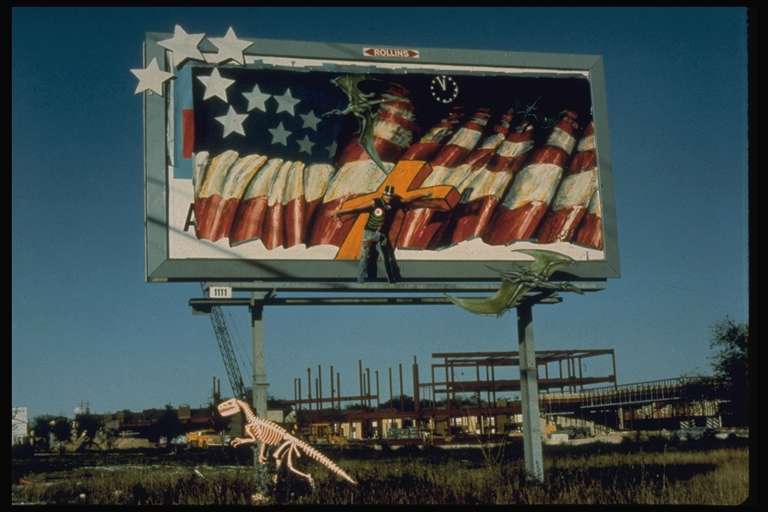
Maybe Vermont Should Have Billboards


If we did have billboards, (aside from Fairpoint billboards which seem to be exempt from Vermont's anti-billboard legislation) I could invite my old friend Ron English to come up to the Green Mountains and 'improve' them.

Not that Vermonters need any GM billboards as an impetus to go and trade their dinosaurs for a wasteful Pickup 'Truck' SUV that will never pick anything up, not ever. We've already got the Obama/Sanders 'Handouts for Hummers' programme for that incentive... oops I meant 'Cash for Clunkers'.


But the usually environmental, organic-eating, hybrid or suburbu-driving Vermonters might question their complacency if ol' Ron came up to the Green mountains and did one of his famous billboards. Perhaps shocking the liberal Left out of blind faith in the Obama Bailout:


You can read more about the inextinguishable Ron English here. Here are some recent pictures of Ron's work. The historical classics are here, among them CAMEL JR:

24 August 2009

Legislative Changes that We Need to Survive


The Case for Local Wheat and Bread in Vermont by Erik Andrus (Good Companion Bakery) is extraordinarily well-written; nay, timeless. It shows what we need to do if we wish to continue to eat in Vermont, yet very little of it can happen within the current legislative and tax milieu. Secession or no secession.

Somalia have less energy than we do, in Vermont we'll have less energy soon and lots of walking too... are they better off? In Somalia, most of the land is owned by a few families that keep it out of production, preferring to skim the cream and speculate on the rest.

In Vermont we have an ass-backwards tax system that encourages speculation, by taxing us on capital improvements to the land; e.g. improving fertility through means natural or petrochemical, rather than taxing on the unimproved value, a value which is created by the community. That value is a common resource; our Commons.

Let me elaborate. Fertility added to the soil (maintained through constant renewal) is Capital. It is not the Land itself, which is part of Vermont's Commons. The Towns and the State Government currently act as a parasite on the labour of Vermonters and especially on the farmer, who, acting as capitalist, improves the land.

The Towns serve to represent absentee landowners, who manifestly pay little to no tax on the speculative value of their landholdings. This windfall makes the value go up, why would I sell it to you today for $100,000 if it may be worth $150,000 next year, and also pay no tax if I hold it out of use? The end result is development in sprawl --- and the destruction of good agricultural land. You see this landscape today, all over Vermont. Suburbia is made though the driver of land speculation, which should rightfully be discouraged through taxation, but is today not only encouraged but highly subsidised by our 'representatives'.

Homesteaders, on the other hand, are taxed highly. In the town where I live, residents have to pay a higher property tax rate than nonresidents... for no municipal services or amenities, not so much as a crosswalk, a bike rack, a park & ride, or a school zone. Homesteaders get one day of rant per year at Town Meeting, as a result of which nothing changes.

Among Vermont's absentee landowners are IBM, Middlebury College, Vermont Yankee, various logging concerns and springwater bottling companies... you get the picture. Here's how the game works: Draw off the natural resources, get rich and pay nothing (in fact Montpelier will give you incentives and subsidies). Try to make an honest living, pay high taxes --- and stay poor. Labour and Capital are in the same boat, and keep getting played off against each other by the Left. It is the tragic history of an ever-poor state, not dissimilar to Ireland in the 19th Century or Somalia today.

It is imperative that the Towns change the property tax structure to recapture the lost revenue of the Commons. The destruction of speculative land values is already being accomplished by the land bust of this past year. Then, the rest of what Mr. Andrus writes can easily fall into place. It's that or starvation and mass migrations.

19 August 2009

Everyone Tries to Walk Away with a Piece


Guns and Butter
is an excellent radio interview with Dmitry Orlov: 'Orlov's repeated travels to Russia throughout the early nineties allowed him to observe the aftermath of the Soviet collapse first-hand. Being both a Russian and an American, Dmitry was able to appreciate both the differences and the similarities between the two superpowers. Eventually he came to the conclusion that the United States is going the way of the Soviet Union. His emphasis is on all the things that can still be made to work, and he advocates simply ignoring all that will fall by the wayside.'

Usually I try to ignore what's happening back in the States, as it's too overwhelming. Try to focus on Vermont. Too much on the Web focuses on the 'We', as if there's any real nation of 'We'. There ain't, though few will see that the emperor has no clothes until imports dry up. Most're assuming that the US will last forever, just as folks in the Soviet Union assumed. Yeah. Virtually overnight, most of the loyal republics elected to go their seperate ways.

When I say 'We' I mean Vermont. A viable nation; perhaps together with Maine and the Maritimes, perhaps not. Economically, we're on our own anyway.

At some point the US Empire will no longer be able to borrow from overseas. The USD will have lost its status as the world's reserve currency. The US Empire, regardless of the new administration, are aligning with the last days of the USSR, with its record trade and fiscal deficit, military expenditure and overreach, and currency failure.

The new administration in Washington are staking everything on re-starting economic growth at ever-increasing speculative rates. At some point, people are going to realise, 'this cannot go on'. Do you believe that it can go on?

Orlov's blog is at cluborlov.blogspot.com

17 August 2009

Scott Nearing, Vermont's Founding Father?


Your government is no longer mine - Scott Nearing, The Making of a Radical: A Political Autobiography [Harborside, Maine: Social Science Institute, 1972, p. 152]

We maintain that a couple, of any age ... with a minimum of health, intelligence and capital, can adapt themselves to country living, learn its crafts, overcome its difficulties, and build up a life pattern rich in simple values and productive of personal and social good. - Scott & Helen Nearing, The Good Life'.


Recently, Thomas Naylor was kind enough to invite me to a lecture at Middlebury College about Scott Nearing, an anti-war radical who was blacklisted from academia for, among other things, his unpopular stance against child labour (The Solution of the Child Labor Problem).

Nearing became a Vermont Homesteader in the mid-Twentieth Century and successfully set up a large scale maple sugaring operation in Winhall, Vermont. He and his wife Helen wrote a book about the experience called, Living the Good Life: How to Live Simply and Sanely in a Troubled World. The Nearings also travelled the world to teach about (among other things) the importance of the rebuilding soil. This was at a time when almost nobody questioned the rise of agribusiness and factory farming, despite the Dust Bowl.

Did Nearing's life and work change the course of Vermont history? He certainly attracted more than his share of interesting people to Vermont, reversing the brain-drain. Yet Nearing gets scant mention in the Vermont histories that I've read.

Nearing's Biographer Saltmarsh wrote, 'Nearing moved through a series of secessions — from Christianity, from politics, and finally from American society itself. He voyaged to the wilderness as if on a pilgrimage to a sacred place. His experience, along with a deeper understanding of American culture, led to the inescapable consciousness that capitalist cultural dominance was too strong to eliminate and therefore too powerful to control or mold...'

In 1945, Nearing wrote to Truman, who had just destroyed two cities in Japan with atomic bombs, 'Your government is no longer mine'. Is Scott Nearing the spiritual 'Founding Father' of the Second Vermont Republic?

Regardless of your opinion, this is essential reading for anyone interested in the evolution of the Vermont independence movement... whether you're working toward secession or just feel that it's important to build the soil and sequester carbon. The Good Life is available from GoodLife.org or from Amazon. A good short biography may alse be found on the web here.

12 August 2009

What Vermont and Russia have in common


The 1990s economic disasters in Russia under Boris Yeltsin hold a lesson for Vermont, itself seeking independence from a collapsing empire. What do vast Russia and tiny Vermont have in common?


The lesson concerns the privatisation of what we're calling the Commons; that is, the Land, the natural resources, all natural opportunities, anything provided by nature that is not the product of our work. It is the life and work of each community that adds to the value of the Commons. Currently, the value of the Commons is largely siphoned off and removed from Vermont. We resemble a colony, rather than a State. Speculation raises the market value of land especially, to a point where we can barely subsist. If you recall what the news media said, they said that the 'housing' bubble burst. What exactly burst? Was it the cost of your depreciating housing stock with the leaky roof, or was it the lucky location of that house that added so much to its market value?


Back in the nineties, Prime Minster Evgeny Primakov proposed a resource-rent tax to finance the nation's recovery from the collapse and breakup of the USSR. His proposal was to tax the profits of natural resources, which have production costs and high windfall. That would have retained rather than liquidated the seventy-plus years of Soviet capital investment. A corrupt Duma chose to give the profits to their associates, who became the Oligarchs. The Duma did what our own esteemed legislature in Montpelier have been doing for even longer, that is, sell off the shares to non-Vermonters.


Professor Herman Daly of the University of Maryland, wrote a letter to the Duma in 1998, proposing the same. I am not sure if Professor Daly's letter or Primakov's proposal came first; I'm sure there were lots more people who felt the same way:


While it is true that land and natural resources exist independently of man. and therefore have no cost of production, it does not follow that no price should be charged for their use. The reason is that there is an opportunity cost involved in using a resource for one purpose rather than another, as a result of scarcity of the resource, even if no one produced it.


But if we tax wages and profits too heavily then the some of the value added to natural resources and land by labor and capital will indeed disappear. The natural resource throughput begins with depletion and, after production and consumption, ends with pollution. Putting the tax at the beginning of the resource flow through the economy (throughput) is better than putting it at the end. A resource tax at the point of depletion induces greater efficiency in production, consumption, and in waste disposal.


Mayor Yuri Luzhkov of Moscow cited the ‘stealing, squandering, and distribution of natural resources and the largest sectors of industry to those who could not support their development.’ Gary Flomenhoft, if you read vtcommons.org at all, has not only documented the exact same thing about Vermont, but has gone further than the Mayor and given it a dollar value.


In an independent Vermont, we have to decide what to do about our Commons. If we create a Leftist government, we'd have to 'take' back what is ours... and probably remain as marginalised in world trade as Cuba under the Castro brothers.


Or we could move to the right, make no changes, and trust in the 'invisible hand' to transform the current corporate owners into responsible capitalists, rather than speculators. This is Montpelier's current solution, also not viable. There is a third way.


The third way, neither right nor left, is for government to shift tax away from productive activity such as wages and capital investments, and collect the _unimproved_ value of land, resources, timber, radio frequencies, opportunities; that is, the Commons. In the classics of Economics (which virtually nobody in academia ever reads), men such as Adam Smith, Ricardo and Henry George, called the value of the Commons, 'Rent'. All three agreed that a tax on Rent would mean the least hardship on society. Nothing radical here, so far.


I think it would be a good idea to allow the titular 'owner' of any part of our Commons to retain some small percentage of the rental tax, in order to capitalise it for sale. This would draw 'local' economic activity back into the state in a way that far huger tax breaks have failed, as well as keep the IBMs of the world from crying to a truncated US for intervention. Vermont will remain a cash cow, drying up only slowly.


Critics of the third way (defined here) often cite the popular view, that keeping taxes low on undeveloped land also keeps it from being developed. That plays right into the hands of the speculators, who are used to virtually tax-free Vermont investments. All that keeping taxes artificially low accomplishes is to force leapfrog-style development ever outward, into the sprawl that you see today! Is that 'green', having to drive through the sprawl? Is it cost-effective for the wage-earner and capitalist, who has to pay the vastly increased infrastructural costs of sprawl?


I look forward to debating these and other ideas, and hope beyond hope that we will get the chance to debate them in the context of a free and independent Vermont. Please use the comments section to poke holes in my arguments, and add your own ideas!


The Basic Factors of the Production of Wealth, and their Functions

05 August 2009

Health 'Insurance': We're on our own.

Last night I with my local volunteer fire department did fire duty at the county fair. The only 'incident' that occurred was bandaiding a young man who came to our tent with a scrape. We also cut the rear silencer off our aging pumper to reweld, as the imported replacement is too difficult to get and too expensive for our tiny budget. We know that we're on our own; there's no government that can help us be a proper fire department. It is a generally accepted thing.

Not as generally accepted as with health care, which everyone needs (some more than others, but it averages out) as much as a fire department, maybe more. The political nonsense that's going on serves to distract from the overall collapse, let people think they are not on their own with regard to health care. This whole debate that we're having is a distraction, whilst the O-Team loot what's left of the country, borrow trillions from the Chinese and Saudis, consolidate control, and attempt an even greater imperial overreach than happened in the Bush years. I repeat, we're on our own.


(As if there's any we. Here in Vermont, I'm one of many successionists who have known this for a long time. You will have to decide for yourself, if you happen to live in the lower 47, whether to continue waving the imperial flag as hospital bills eat you out of house and home.)

We, hmmph. Sounds like a religion. Distractions seem to be religious in nature. George Orwell wrote, throw"...your mind open ... letting the ready-made phrases come crowding in. They will construct your sentences for you, even think your thoughts for you... at need they will perform the important service of partially concealing your meaning even from yourself."

It took a bit longer than Orwell thought, but I believe that we are there.

24 July 2009

'Green' Empire Cracks Down on Alternative Local Energy


That's right folks... or hadn't you known that the Kenyan's administration was a sham, telling people who were sick of Bush exactly what they wanted to hear, whilst in fact continuing the same old destructive, anti-survival polices? In the clear, without public criticism?

What a coup!

My small Lister engine/generator was held up in port by the EPA and then the dealer was harassed by inspectors, and just sent me a refund, afraid to complete the deal. This is a generator that can burn waste oil, diesel, really anything at hand.

I still feel as if I cannot speak out on the above. Vermont's liberal-left seem to be still on some kind of anaesthetic, euphoric drug; the O-Pill. They buy more hybrids and green products to choke the green landfills, whilst the Collapse proceeds. 'Things fall apart, the centre cannot hold...' Today Hillary is sending $200 million to the Palestinean Authority, Gov. Douglas is building a roundabout but letting bridges fall, and continues killing public transport in our (I can't even call it a State, our Guard have been illegally sent to Iraq, prisoners themselves) economic colony of Vermont.

Yet not a peep of discontent, aside from Vermont Secessionists, the admitted 'Wingnuts' of Vermont. Everything's just as wonderful as in 2001 when Reagan took office. Bernie himself has committed to 'Lead not secede' or somesuch nonsense, wasting time better spent fixing the electrical grid. Or maybe he can't really speak openly. Congressman Leahy is celebrating the Verwandlung of our Guard into more Iraq cannonfodder. They're not providing leadership, they are managing us on behalf of the Empire.


Well, referring to --- even thinking about the US is a waste of valuable time better spent learning to care for chickens, digging up the lawn, planting & canning vegetables.

I wish all the folks well, who are expending their energies in order to improve, reform, fix or otherwise prop up the US. Collapse is coming. The US are not worth the time. We have to fix Vermont, we've got enough problems, though far fewer than in the Lower 47.


This Winter will be telling. As imports dry up, people can't get things fixed, the crappy consumer goods from China fail (including bits to keep their 'green' traffic-obstructing hybrids going) and aren't replaced... we shall see.

One final image is from a fiercely intelligent gentleman named Peter Moss from Fairfax who stood for the Vermont House in 2008 and is now standing for the US Congress. The Donkeyphant speaks volumes. Peter's website is petermoss.org.


07 May 2009

Rebellion: On Language, the Metric System

How can I personally rebel, without getting the sack and making my family homeless? It's all well and good that some of the highly intelligent folks that I've met recently can refrain from paying taxes to the Empire and still make do, but for the moment I have to keep rendering unto Caesar. (My time will come.)

For the moment, here are a few small things that go a long way because I can be a virus in the corporate world:

1. I speak and write in Standard English.

You're thinking, wtf?!? Well, think about it. The Empire think it's the norm, the 'greatest country etc.'. That's so bloody provincial, and what's worse, they don't even know it. They exclude themselves from the rest of the world, relying on TV for how to think and speak.

Here's the deal. American English (including English spoken with an American accent) is spoken only by the inhabitants of the US, which are a fraction of English-speaking countries. The US inhabitants are chauvinistic enough to remark that anything outside of their narrow world is 'British English', a term which makes no sense unless you haven't studied Geography (with a GPS made in China, 'why bother?', I'm told).

So I set my document base language and spell-checker to English/Canada, (here is how), eschew all but Standard English, though I do admit some LOLCats influence ;) I speak in public and teach quite a bit, and have told hundreds of other people like myself, trapped in the Fortune 500 prison, exactly why.

2. I refer to Corporations in the plural.

Looks a bit weird at first, but get used to it. I simply refuse to recognise the 'Corporate Personhood', in which the Empire grant special privilege to corporations. With which privilege they sack our Commons.

Standard English, by the by, refers to corporations in the plural. I recommend that we all do so in Free Vermont.

2. I use the Metric System, exclusively.

An Independent and Free Vermont must practise Free Trade with the entire civilised world, if we are to survive. Everything should be measured the same. Why did the Empire almost go metric in the early 1970s, and then switch all the signs back to their accursed old system? Why do Americans fail to function in the larger world? Can't tell time, temperature, distance, can't leave the tour bus.

Fortunately, with secession, that's no longer Vermont's problem. Let us [today] cast off the provincial and obsolete measurement system of the Empire, along with its increasingly worthless currency, and finally become part of a larger world !!!

30 April 2009

Obama: another Gorbachev, or John Law ?

The latest 'messiah' may fancy himself the next FDR. I thought Dmitry Orlov had it right when he compared Obama with Gorbachev, see Orlov's Perestroika 2.0 beta

http://www.energybulletin.net/node/47808

Both tried to keep a dying empire alive, rather than build something new. 'An important caveat still applied: the problems always had to be cast as “specific difficulties,” or “singular problems” and never as a small piece within the larger mosaic of obvious system-wide failure. The spell was really only broken by Yeltsin, when, in the aftermath of the failed putsch, he forcefully affixed the prefix “former” to the term “Soviet Union.” At that point, old, pro-Soviet, now irrelevant standards of patriotic thought and behavior suddenly became ridiculous...'

Douglas French, who runs the Mises Institute and wrote Early Speculative Bubbles & Increases in the Money Supply, goes a step further and compares Obama to the 18th Century speculator/crook, John Law:

http://mises.org/story/3438

'Law's use of a bank to create money out of nowhere to pay for government programs was imitated by Roosevelt, Hitler, and Mussolini.

'We can only hope that [Obama's] career will be short and that the Fed's days are numbered.'

Well, frack, I'm doing it again, paying attention to the Americans. Bad disctraction. Back to the lawn-digging-up and garden-planting, I need to eat when the supermarkets go empty.

28 April 2009

MySQL Future

I'm glad IBM didn't get Sun. No matter what you say about Oracle (tell me something new!), there's at least some hope, and the ability to, as another blogger put it, to become involved in the community: http://blog.devx.com/2009/04/will-oracle-continue-funding-s.html

Early this decade, Interwoven acquired Scriptics and scuttled TCL/TK after promising support. I have always considered incrTCL, the OO version of TCL/TK, to be far superior to Java, the source of much bloatware. But, after being scuttled, TCL/TK went open source and was available to small dynamically growing companies who didn't have to pay huge licencing fees (even if metanationals largely avoided TCL/TK afterward).

IBM are a real killer of technology. They are also a killer of the social and economic landscape, holding tax-free lands in my home, Vermont; speculating on their value, and laying a few workers off each time the legislature makes noises about taking away some of their subsidies. (Go to the Holocaust Museum if you want to see more of IBM's real history.)